


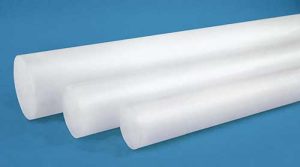
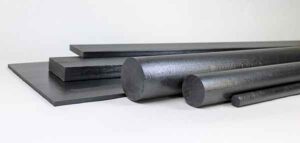
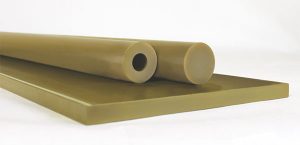
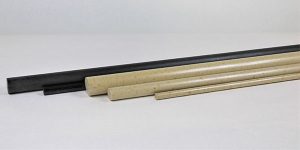
In keeping with our policy of open communications on environmental and safety matters related to our products, Drake Plastics offers the following information on PFAS:
DRAKE PLASTICS PRODUCTS AND PFAS
Drake Plastics converts high-performance thermoplastic resins into semi-finished extruded shapes for machining, and into injection molded parts. Certain grades of these resins contain small amounts of PTFE that serve as processing aids, and as functional additives that improve wear resistance.
Certain grades of the thermoplastic resins that we convert into parts and shapes contain small amounts of PTFE as process aids. Some bearing grades contain larger amounts of PTFE as functional additives, primarily to reduce a material’s coefficient of friction and improve its wear resistance. None of the resins that Drake converts into shapes or parts contain PFAS as defined by U.S. regulatory agencies.* Furthermore, Drake Plastics does not add PFAS or any process aid of any kind to the resins we convert.
PFAS AND PTFE DIFFERENCES
While PTFE is not classified as a conventional PFAS according to US environmental regulatory agency definitions, it shares some similarities in carbon-fluorine bonds. However, PTFE also differs significantly from PFAS in its chemical structure and properties.
PFAS, especially in aqueous solutions and as emissions from cookware or from other sources from which they can become airborne, are under justifiable scrutiny in many jurisdictions because of the risks of environmental and biological harm they pose.
PFAS such as perfluorooctane sulfonic acid (PFOS) and perfluorooctanoic acid (PFOA) do not break down in the environment and can move through soils and contaminate drinking water. They also build up (bioaccumulate) in fish and wildlife.
Conversely, PTFE is a very large molecule that is unable to enter the human cell passively due to its size. Moreover, it does not have the chemical or structural properties it necessary to interact with other biomolecules that would enable PTFE to move into human cells. In addition, PTFE doesn’t bind to cell surface receptors, nor does it signal events within the cell.
PTFE IS SAFE WHEN USED AS INTENDED1
Since PTFE is not subject to passive or active transport into human cells and does not bind to the surface receptors necessary for cell signaling, it is not bioavailable2, meaning it is not absorbable physiologically. In other words, because the PTFE molecule cannot get into or bind to human cells, it is safe for the end user when used as intended3.
Devices made from PTFE in solid form have been FDA approved for decades. PTFE is also well-established with a long clinical history of human implantation. It has been approved by regulatory bodies around the world for several decades and is used extensively in a range of vascular indications.
PTFE COMPOUNDED IN DRAKE PLASTICS IS INERT
PTFE in solid form and when compounded into other polymers is inert and does not leach. It is also highly stable and very resistant to thermal degradation. In fact, it would require about 25 hours of continuous exposure to temperatures above 400°C (752°F) for PTFE to begin to degrade4. Burning or overheating PTFE over 400°C (752°F) or products that contain PTFE releases trace amounts of carbonyl fluoride and hydrogen fluoride. Inhalation of low concentrations of hydrogen fluoride can initially include symptoms of choking, coughing, and severe eye, nose, and throat irritation.
PTFE’s degradation temperature is significantly above temperatures at which our products, or any thermoplastic polymer, could possibly function in actual applications. Consequently, components made from our PTFE-containing products are safe when used within their performance limits.
For these reasons, it is our understanding that the PTFE compounded into the products that we extrude, injection mold and machine into parts does not pose a risk to users of these products or the environment Nevertheless, we believe it is our responsibility to list all Drake products that do and do not contain PTFE in their formulations:
Drake products with no PTFE
- Ryton R-4 PPS
- KetaSpire NT PEEK
- KetaSpire 30% Carbon-filled PEEK
- KetaSpire 30% Glass-filled PEEK
- Victrex HT G45 PEEK
- Ultem 2300, 2400
Drake products that contain PTFE
- Torlon 4203/ 4203L (1/2%)
- Torlon 4275 (as functional component)
- Torlon 4301 (as functional component)
- Torlon 4435 (as functional component)
- Torlon 5030 (1%)
- Torlon 7130 (1%)
- Victrex 450FC30 PEEK (as functional component)
- Victrex 450FE20 PEEK (as functional component)
*Certain regional agencies such as the European Chemicals Agency (ECHA) are currently taking a broader view of PFAS and include PTFE among these materials, presumably because it shares some similarities in carbon-fluorine bonds. The U.S. Environmental Protection Agency’s current position considers PTFE as being far removed from problematic PFAS, which it defines as those with C-12 fluorinated chain blocks. The latter are not present in PTFE.
1 Henry et al., 2018, Integr Environ Assess Manag 14 Supplement, pp 327-328; L.L. Radulovic, Z.W. Wojcinski, 2014, Encyclopedia of Toxicology (Third Edition); Bruno Ameduri, 2023, Journal of Fluorine Chemistry, 267, Fluoropolymers: A Special Class of per- and polyfluoroalkyl Substances (PFASs) Essential for our Daily Life; Gerard Puts et al., 2019, Chemical Reviews, 119, Polytetrafluoroethylene: Synthesis and Characterization of the Original Extreme Polymer, American Chemical Society: ACS Publications; Sina Ebnesajjad, 2013, Applied Plastics Engineering Handbook: Processing and Materials, ed. Myer Kutz (Elsevier, 2011), Introduction to Fluoropolymers, pp 63-89; Ebnesajjad, 2014, Fluoroplastics, Volume 1: Non-Melt Processible Fluoroplastics, (Second Edition) Chapter 5, Homofluoropolymer Polymerization and Finishing, (Plastics Design Library: Elsevier Science & Technology Books).
2 Paul Leeson, 26 January 2012, Drug discovery: Chemical beauty contest, Nature 481, pp 455–456; ECETOC Special Report No. 18, Brussels July 2014, Information to be considered in a weight-of-evidence-based PBT/vPvB assessment of chemicals (Annex XIII of REACH); Ming-Qiang Zhang and Barrie Wilkinson, 2007, Drug discovery beyond the ‘rule-of-five’. Current Opinion in Biotechnology, pp 18:478–488; Henry et al., 2018, Integr Environ Assess Manag 14 Supplement, pp 327-328.
3 Paul Leeson, 26 January 2012, Drug discovery: Chemical beauty contest, Nature 481, pp 455–456; ECETOC Special Report No. 18, Brussels, July 2014, Information to be considered in a weight-of-evidence-based PBT/vPvB assessment of chemicals (Annex XIII of REACH); Ming-Qiang Zhang and Barrie Wilkinson, Drug discovery beyond the ‘rule-of-five’, Current Opinion in Biotechnology 2007, pp 18:478–488; Henry et al., 2018, Integr Environ Assess Manag 14 Supplement, pp 327-328; L.L. Radulovic, Z.W. Wojcinski, 2014, PTFE (Polytetrafluoroethylene; Teflon®) in Encyclopedia of Toxicology (Third Edition).
4 Plastics Industry Association, Guide to The Safe Handling of Fluoropolymer Resins, 5th Ed., https://access.plasticsindustry.org/ItemDetail?iProductCode=BU201&Category=PUBLICATION; Thomas Douglas and Ann W. Harman, November 18, 1964. Relative Enthalpy of Polytetrafluoroethylene; Peter R. Hondred et al., 2013, Degradation kinetics of polytetrafluoroethylene and poly(ethylene-alt-tetrafluoroethylene).